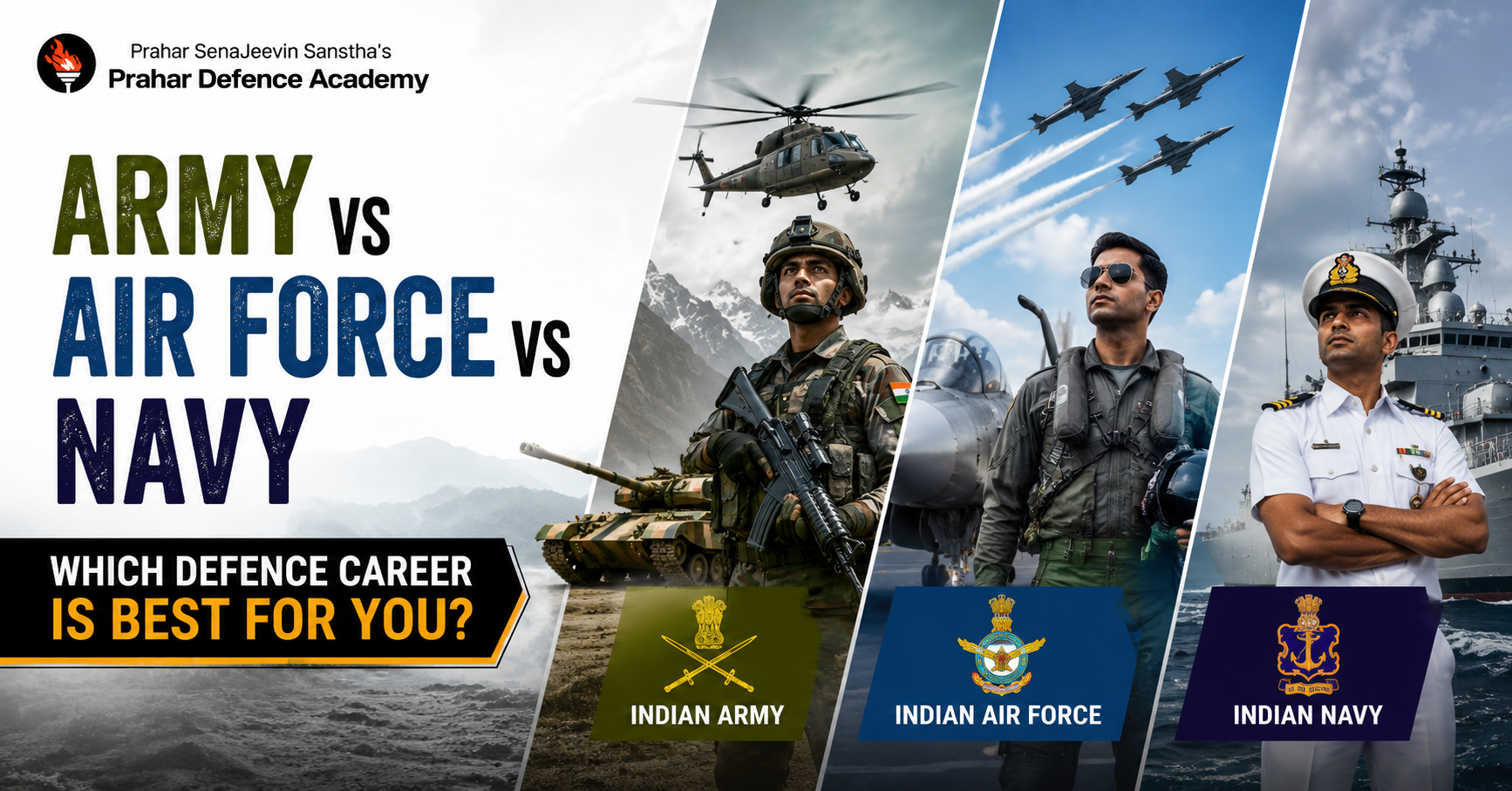
Army vs Air Force vs Navy: Which Defence Career Is Best for You?
Millions of students are interested in pursuing a career in the defence services in India due to various reasons that include reputation, salary, perks, etc. Before starting their preparation for NDA, CDS, or similar exams, they all face a common problem - What to choose out of an army vs air force vs navy career? Out of the choices of Indian Army, Indian Air Force, and Indian Navy that aspirants have, the right choice depends on an individual's interests, personality, physical abilities, lifestyle preferences, and career goals.
Which Defence Job Is Best in India?
If you are searching for which defence job is best in India, then you should know that no single job in this sector is universally the best one. Among the defence career options after 12th in India, which job you consider as the best one depends on what your personal aspirations are. If you do not have any clear goal set for yourself, then you need to know about the jobs, career progression, lifestyle, training, and other things about a career in the Indian military’s three branches.
1. Indian Army
An Indian Army officer works in border security, counter-insurgency operations, disaster relief, and peacekeeping missions. The following are some Indian Army roles that you can get with a great scope of promotions.
Infantry Officer
Armoured Corps Officer
Artillery Officer
Engineer Officer
Signals Officer
Intelligence Officer
Army Aviation Officer
Logistics and Administrative Officers
2. Indian Air Force
The Indian Air Force focuses on air defence, aerial warfare, surveillance, transportation, and strategic operations. Some of the Indian Air Force (IAF) job roles that you can get out of all the defence career options after 12th include:
Flying Officer (Pilot)
Fighter Pilot
Transport Pilot
Helicopter Pilot
Air Traffic Control Officer
Technical Branch Officer
Ground Duty Officer
Logistics Officer
3. Indian Navy
In the Indian Navy, your role would revolve around India's maritime interests and securing sea routes, coastal regions, and strategic ocean territories. It is made for students who are interested in ships, submarines, engineering systems, and global deployments. Their roles include:
Executive Officer
Naval Pilot
Naval Observer
Engineering Officer
Electrical Officer
Logistics Officer
Submarine Officer
Naval Architect
Army vs Air Force vs Navy Salary Comparison
The basic pay structure for officers in all three services is governed by the Government of India under the 7th Central Pay Commission. Hence, in the army vs air force vs navy salary comparison, the salaries of defence personnel across the three branches are largely similar. This is because defence personnel are paid according to rank rather than service branch. Meanwhile, the overall earnings vary based on allowances such as:
Military Service Pay (MSP)
Flying Allowance
Field Area Allowance
High Altitude Allowance
Sea Duty Allowance
How Is the Life in Army vs Air Force vs Navy?
There are a great number of pros and cons of defence services in India, which are seen mostly in the lifestyle of an officer. During NDA career options comparison, most of the students focus only on the salary, perks, and reputation of a defence career by choosing it. However, it is important for them to consider the future lifestyle of a defence personnel and prepare themselves for the same. Below is what you will get in a life in army vs air force vs navy.
In the Indian Army
Frequent field postings
Physically challenging work conditions
Strong teamwork
Involvement in disaster relief initiatives and emergencies
In the Indian Air Force
Working with aircraft and sophisticated systems
Highly specialized training
Better work-life balance in many roles
Focus on precision and technical excellence
Opportunities in aviation-related careers
In the Indian Navy
Long periods onboard ships
International port visits
Maritime operations and exercises
Technical and engineering responsibilities
Exposure to multinational military environments
How to Choose One Between the Army, Air Force, and Navy?
Choosing the best defence career for students in India is not an easy choice. When you are preparing for a defence exam at the best defence academy, you should evaluate the following factors.
1. Your Interest
Before starting your defence exam preparation, the first question you should ask yourself is what excites you the most. Choose:
Army if you enjoy leadership in field operations
Air Force if you love aviation and technology
Navy if maritime operations and ships fascinate you
2. Understand the Lifestyle Differences
Every branch in the Indian military has a unique lifestyle whose preference varies among students. Ask yourself:
Can I adapt to long deployments?
Do I enjoy outdoor challenges?
Am I interested in advanced technical systems?
3. Evaluate Your Physical and Technical Strengths
Choosing a defence career also depends on how good your physical endurance and technical strengths are.
Army roles demand higher physical endurance
Air Force roles need great technical knowledge
Navy roles demand a combination of technical expertise with operational readiness
Army vs Air Force vs Navy: Detailed Comparison
Conclusion
All candidates aspiring for a career are varyingly fit to join the Indian Army, Air Force, and Navy. The confusion arises when a candidate has to find the right branch where they can fit in and handle their roles and responsibilities easily. You can make this choice easily by evaluating your interests, strengths, lifestyle preferences, and long-term career goals. Another method to find the best defence branch for yourself is by taking the right guidance from a professional defence exam coach.
Enroll at Prahar Defence Academy, the top NDA, CDS, SSB, and the top AFCAT coaching classes Nagpur, to get clarity on your defence career choice and get the best possible preparation to crack the exam smoothly.
Frequently Asked Questions (FAQs)
Q. What are the top 5 Defence jobs in India?
The top 5 defence jobs in India are commissioned officer, IAF officer, technical officer, Indian Coast Guard officer, and CRPF officer.
Q. Who is rank 1 in the Army?
The Field Marshal rank held by the Chief of the Army Staff (COAS) is the highest rank in the Indian Army.
Q. Which Army is best for girls?
There is no single best military branch as the choice varies for all candidates. A career in the Indian Air Force is often considered the best choice for girls or female candidates.
Q. Which is best in NDA, Army, Navy or Air Force?
Out of the Indian Army, Navy, and Air Force, no single branch is entirely the best one. Which branch you consider as the best one depends on your own interests, strengths, lifestyle, role preferences, and educational qualification.
Q. Which job is better, the Army or the Air Force?
No job in the Army or the Air Force is better. The jobs in both branches are different in their roles and responsibilities, and hence the choice of the better one varies for all students.